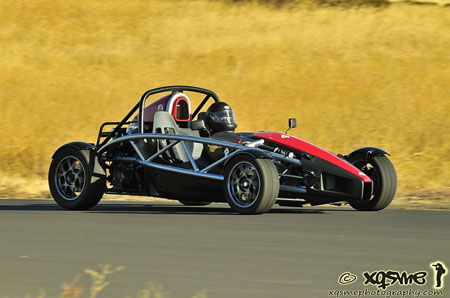
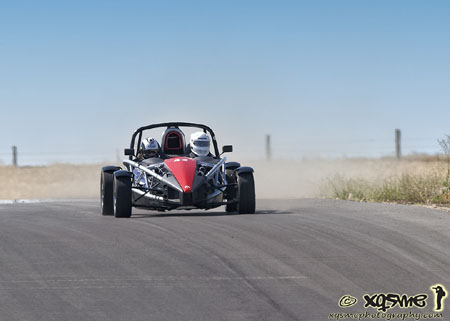
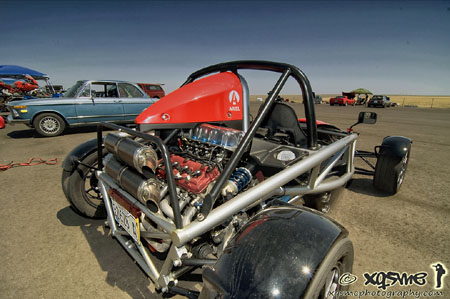
10/14/08 (updated 10/16) Nope, it still doesn't work. But I did did learn a few things today which are quire useful so as a test it was valuable. This time I mounted a clear catch can where I can seet while driving (should have done it earlier, really).

The main thing I learned is that oil only comes out on the straights under full power, over 7K RPM. So it's not the cornering which is causing the problem and therefore initially I was chasing the wrong solution with the baffles and such. Also what comes out now is not foam but pretty much solid oil.

As John had reminded me, just one psi of pressure will push oil 34 inches up. Since the final outlet on the de-aerator tank is only 15" above oil level in the main tank, it only takes 1/2 psi of back pressure in the vent line between the two tanks to push the oil up the drain tube and outside. Which is exactly what seems to be happening. So the next fix to try would be a much bigger vent line (a -12 instead of a current -6, also bigger than the -10 drain tube) and removal of the aluminum mesh screen in the de-aerator tank that I put in there in an effort to help de-foaming. Those changes may or may not fix the issue since after all that I'm still only able to run 4 quarts of oil in the tank where it ideally should be at least 8. But it's worth a try just for education if nothing else. I'm now also trying to figure out where I can squeeze in a tank twice the size of the current one.

Another item of note is that oil temp never comes up above 180 so the oil cooler I have may not be needed, but a second water radiator might be helpful. So another change I may do over the winter is modify the cooling systems accordingly.

The good news is that whatever solutions I come up with can be tested on a dyno over the winter, no need for taking it out on the track (although as an instructor my track time is cheaper than dyno time). This also means that my dp1 tank design can be tested by John on his engine dyno during initial run-in, before the engine is shipped to me. And that is a very good thing. This finding alone is worth all the hassles I've been through so far. Which is exacly why Bikini is the testbed for the engine, I can deal with powertrain issues without worrying about the chassis so that in the dp1 I can then deal with the chassis without worrying about the powertrain. Therefore things are actually working according to plan, albeit much slower and less smoothly than hoped for. But, as I always say, if it were easy then anyone could do it :)

UPDATE: A reader sent me a link to a very helpful article (thanks, Pierre!). It deals with crankcase vent system design and talks about the volume of blow-by gases. According to the article, the worst case blow-by volume can be as high as 3% (on overrun from high rpm, which coinsides with my observation that there is a surge of gas out the vent after lifting off the throttle - it didn't intuitively make sense but now it does). For a 2.8L engine spinning at 10K rpm this could amount to as much as 420 liters per minute (that's roughly 7 quarts per second)! In reality it is likely less than that but probably not far off. Of course all this stuff gets sucked out by the scavenge pump and pushed into the drysump tank, then it has to come out the vent. Really puts my choice of a -6 (3/8" diameter) vent line in perspective and makes it look pretty ridiculous. Live and learn. I now need to plan out my winter experiments, on this and other fronts. As of today I officially have added motivation due to some business developments - but more on that later, when all is said and done.